
Introduction
Enterprise Resource Planning or ERP has become an important tool for SMEs in Malaysia that want better control over business operations, finance, inventory, and daily workflows. Many local businesses today operate in a more competitive environment, with rising customer expectations, tighter margins, and increased need for accurate reporting. Because of this, more SMEs are moving away from manual spreadsheets and separate standalone systems toward a centralised ERP platform.
This article is written to help Malaysian SME owners, managers, and decision makers understand what ERP means in a practical way rather than a technical perspective. It explains how ERP systems support business efficiency, productivity, and long term growth while also listing ERP solution providers that are commonly explored in Malaysia.
The article includes a summary of ERP benefits for SMEs, a list of ERP providers that are relevant to the Malaysian market, a comparison table, and guidance on when SMEs should start thinking about ERP adoption. It also shares selection tips that can help avoid common implementation mistakes.
Disclaimer
The company listing in this article is shared based on our research perspective and does not represent a ranking. Readers are encouraged to contact the companies directly to confirm that the solution fits business needs. All information is correct at the time of writing. If you notice any inaccurate or outdated information, you are welcome to reach out to us so we can review and update it.
| Table of Contents |
| Introduction |
| Disclaimer |
| Top ERP Solutions for SME in Malaysia |
| ERP Solution Comparison Table |
| How ERP Systems Support Malaysian SMEs |
| When an SME Should Consider an ERP System |
| How to Choose the Right ERP Solution Provider |
| Common Mistakes SMEs Should Avoid |
| Conclusion |
Top ERP Solutions for SME in Malaysia
Below are ERP providers and platforms commonly explored by SMEs in Malaysia. Each listing includes business location, founding year, website link, explanation of the company and services, and who the solution is best suited for.
1. SAP Business One Malaysia Partner Network

Location
Kuala Lumpur Malaysia
Founded
2002
Website Link
https://www.sap.com/sea/products/business-one.html
SAP Business One is widely known among Malaysian SMEs that require a structured ERP system for finance, inventory, purchasing, and operations. It is designed for growing companies that want a single system instead of multiple separate software tools. Many Malaysian solution partners provide implementation, training, and localisation support for taxation and reporting. SAP Business One is often chosen by SMEs that plan to scale in the coming years because the system supports expansion without needing a full platform migration.
Best Suited For
SMEs that require a scalable ERP solution with strong finance and inventory features and plan to support future business growth.
2. Oracle NetSuite Malaysia

Location
Kuala Lumpur Malaysia
Founded
1998
Website Link
https://www.netsuite.com/
Oracle NetSuite is a cloud based ERP platform that supports financials, inventory, procurement, CRM, and reporting in one ecosystem. It is commonly considered by Malaysian SMEs that operate across multiple locations or require real time financial insight. Many local consulting partners help businesses deploy NetSuite with customised modules based on industry needs. Since it is fully cloud based, SMEs benefit from lower server maintenance needs and remote access for management teams.
Best Suited For
SMEs that prefer a cloud first ERP system with centralised reporting and multi location business visibility.
3. AutoCount ERP
Location
Kuala Lumpur Malaysia
Founded
1996
Website Link
https://www.autocountsoft.com/
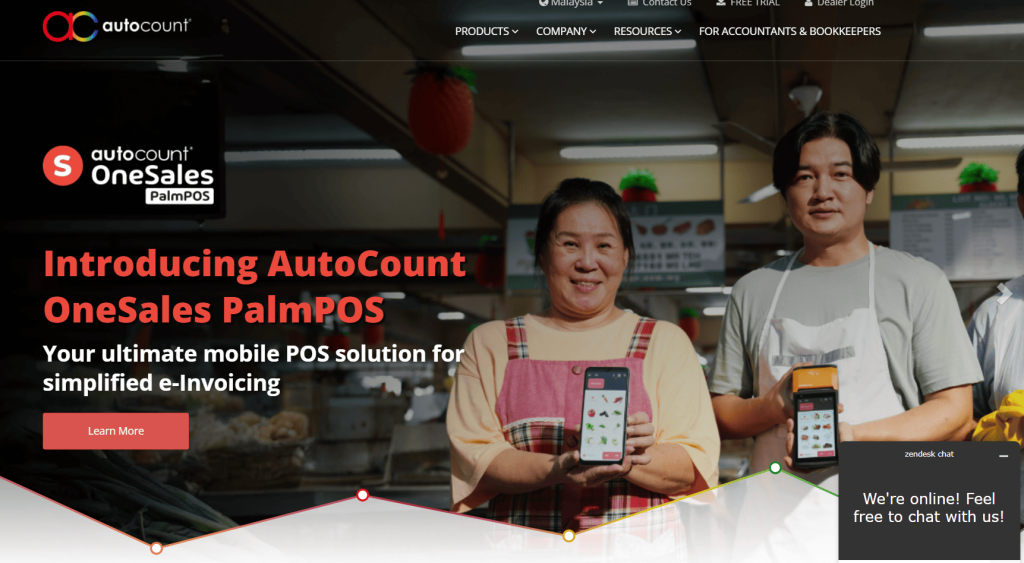
AutoCount is a well known Malaysian ERP and accounting software provider, especially among SMEs in trading, wholesale, and retail industries. The system includes accounting, inventory, invoicing, payroll, and POS integration. Many SMEs choose AutoCount because it is local market friendly and commonly supported by Malaysian resellers and implementation partners. The platform is structured to help SMEs standardise workflows without requiring overly complex configurations.
Best Suited For
SMEs that want a locally developed ERP system with accounting, inventory, and POS integration.
4. SQL ERP and Accounting

Location
Kuala Lumpur Malaysia
Founded
2001
Website Link
https://www.sql.com.my/
SQL ERP and Accounting is popular among SMEs in Malaysia for its accounting and business management modules. The software supports financial reporting, billing, stock control, and business documentation features commonly required by Malaysian SMEs. Local training centres and implementation partners make onboarding accessible for teams with limited IT background. Many SMEs choose SQL ERP due to its affordability and local support ecosystem.
Best Suited For
SMEs that want an ERP and accounting solution that is practical, approachable, and supported by local service providers.
5. HashMicro Malaysia

Location
Kuala Lumpur Malaysia
Founded
2015
Website Link
https://www.hashmicro.com/
HashMicro offers modular ERP solutions that cover finance, inventory, warehouse management, HR, procurement, and CRM. The platform is suitable for SMEs that need flexibility to select only the modules that match current business requirements. HashMicro works with Malaysian businesses across industries such as trading, distribution, education, and services. The system focuses on simplifying daily operational processes so SMEs can reduce manual paperwork and repetitive tasks.
Best Suited For
SMEs that want a modular ERP system that can be expanded progressively as the business grows.
6. Million Software

Location
Petaling Jaya Selangor
Founded
1998
Website Link
https://www.million.my/
Million Software is a Malaysian business software provider known for accounting, payroll, and billing solutions that support small and medium businesses. The system is designed to be simple and easy to adopt for SMEs that are transitioning from spreadsheets or manual records. Many SMEs select Million Software because it focuses on essential business functions without unnecessary complexity, making it suitable for small operational teams.
Best Suited For
SMEs that need a straightforward ERP and accounting solution for daily business administration and financial management.
7. ABSS (formerly MYOB Malaysia)
Location
Kuala Lumpur Malaysia
Founded
1987
Website Link
https://www.abssasia.com/
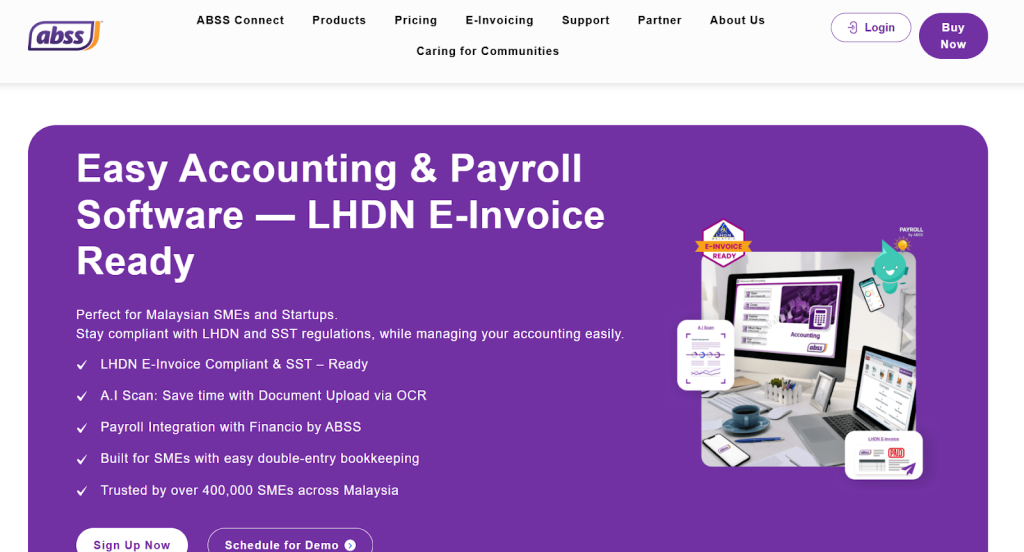
ABSS serves SMEs across Malaysia with accounting and business management solutions tailored for small businesses. The platform helps business owners track invoices, expenses, inventory, and financial performance in a structured manner. It is often considered by SMEs that want a desktop based or hybrid ERP environment rather than a fully cloud hosted system. ABSS is supported by local partners that provide installation, migration, and system training.
Best Suited For
SMEs that prefer a stable and proven ERP accounting platform with local implementation support.
8. Deskera ERP

Location
Singapore with serving presence in Malaysia
Founded
2008
Website Link
https://www.deskera.com/
Deskera is a cloud based ERP platform used by SMEs across Southeast Asia including Malaysia. The platform integrates accounting, HR, CRM, and sales management within one application. It is commonly considered by SMEs that require remote access, simplified reporting, and an all in one business management environment. Deskera focuses on ease of use which makes it suitable for SMEs that are adopting ERP for the first time.
Best Suited For
SMEs that want a cloud based ERP solution with integrated sales, HR, and accounting functions.
ERP Solution Comparison Table
| ERP Solution | Deployment Type | Key Strengths | Suitable SME Profile |
| SAP Business One | On premise or cloud partner hosted | Strong financial and inventory control | Growing SMEs with long term expansion plans |
| Oracle NetSuite | Cloud | Real time reporting and multi location visibility | SMEs with regional operations or multiple branches |
| AutoCount ERP | On premise or hybrid | Local market features and POS support | Trading and retail focused SMEs |
| SQL ERP | On premise | Affordable and widely supported locally | SMEs seeking practical accounting centric ERP |
| HashMicro | Cloud modular | Flexible module expansion | SMEs scaling in stages |
| Million Software | On premise | Simple and easy to adopt | Smaller SMEs and startups |
| ABSS | On premise | Proven SME accounting solution | Traditional SMEs and small enterprises |
| Deskera | Cloud | All in one system with CRM and HR | SMEs adopting ERP for the first time |
How ERP Systems Support Malaysian SMEs
ERP systems help Malaysian SMEs bring different parts of the business together into one connected platform. Instead of managing accounting, stock control, purchasing, sales, and reporting separately, ERP allows these processes to work in a single system. This reduces repeated data entry and lowers the risk of human error.
For many SMEs, one of the biggest advantages of ERP is better visibility. Business owners and managers are able to see financial status, stock movement, and operational performance in a more structured and real time manner. This supports faster and more confident decision making, especially when planning purchasing activities, pricing strategies, or cash flow allocation.
ERP systems also support internal workflow discipline. Teams follow standard processes instead of ad hoc manual steps. This helps improve accountability, record accuracy, and audit readiness. For SMEs applying for bank financing, government grants, or investor funding, proper documentation and financial reports generated from ERP can be very helpful.
In addition, ERP supports business growth and expansion. As transaction volume increases, manual spreadsheets often become difficult to manage. ERP allows SMEs to scale operations without losing control of data, inventory tracking, or financial consistency. For multi branch or multi location businesses, ERP provides central management that helps avoid stock discrepancies and reporting delays.
When an SME Should Consider an ERP System
SMEs in Malaysia normally begin considering ERP when their business operations reach a stage where manual or basic accounting tools are no longer sufficient. Some common signs include frequent stock mismatches, difficulty tracking outstanding invoices, slow financial closing, or heavy reliance on manual consolidation work.
Another indicator is when different departments use separate systems that do not connect with each other. For example, inventory is recorded in one tool while accounting is handled in another. This often leads to duplicate records and inconsistent data. ERP becomes useful because it unifies these functions.
ERP is also worth considering when a business expands its operations. This may include opening new branches, managing larger customer volume, or hiring more staff. At this stage, centralised control becomes important to maintain operational consistency and reduce dependency on individual employees for business knowledge.
SMEs that are preparing for long term growth, digital transformation initiatives, or process standardisation may also find ERP adoption beneficial. Implementing ERP early in the growth phase can help build a stronger operational foundation before complexity increases.
How to Choose the Right ERP Solution Provider
Choosing an ERP solution requires careful consideration instead of relying only on product features or pricing. The first step for SMEs is to understand their current challenges and business priorities. This may include issues such as inaccurate stock levels, delayed reporting, fragmented workflows, or lack of financial visibility.
Next, SMEs should clearly identify the core functions that the ERP system must support. These usually include accounting, inventory control, purchasing, sales, and reporting. Additional modules such as HR, CRM, or warehouse management can be added based on business needs.
It is also important to review deployment preference. Some SMEs may prefer on premise systems due to internal policies, while others may choose cloud based ERP for flexibility and easier remote access. Malaysian businesses should also ensure that the solution supports local requirements such as SST compliance and local financial reporting formats.
Support and training are key areas to evaluate. A suitable ERP provider should offer onboarding guidance, user training, and after sales support to help staff adapt to the system. Speaking directly with the provider or implementation partner allows SMEs to clarify expectations, timelines, and long term support arrangements before committing to the project.
Common Mistakes SMEs Should Avoid
One common mistake made by SMEs is choosing an ERP system based mainly on price without considering long term suitability, scalability, or support requirements. A cheaper system may appear attractive at the beginning but could become limiting as the business grows or requires additional modules.
Another mistake is implementing too many modules at the same time. This may overwhelm employees and cause resistance to system adoption. A gradual rollout is often more effective, starting with essential modules such as accounting and inventory before expanding into advanced features.
Some SMEs underestimate the importance of user training and internal change management. ERP is not only a software implementation but also a process improvement exercise. Without clear training and communication, staff may continue using old manual methods alongside the system, reducing ERP effectiveness.
Another risk is relying on customisation too early. Excessive custom development can increase cost, make upgrades difficult, and create long term dependency on a single vendor. Where possible, SMEs should try to align workflows with standard system processes before considering custom enhancements.
By avoiding these common mistakes, SMEs improve their chances of achieving a smoother ERP implementation with better long term operational benefits.
Conclusion
ERP systems play an important role in helping Malaysian SMEs manage operations in a structured and efficient manner. With better control over finance, inventory, and business processes, SMEs are able to reduce manual work and improve decision making.
The ERP solutions listed in this article represent platforms and providers that are commonly explored by SMEs across Malaysia. Each solution has different strengths and suitability depending on business size, growth stage, and operational needs.
SMEs are encouraged to review features, deployment options, and support availability before selecting an ERP system, as the right implementation can support long term business growth and operational stability.