


Introduction
Malaysia has grown into a trusted global hub for medical technology manufacturing and development. From electronics to precision plastics, the country supports many of the world’s medical device brands. One of the most important steps in this ecosystem is prototyping. This is where ideas are transformed into physical devices that can be tested for safety, usability, and performance before full scale production begins.
In this article, we share a curated list of the Top 10 Medical Device Prototyping Companies in Malaysia, along with practical guidance on why prototyping matters, the benefits of working with Malaysian partners, and how to choose the right company for your project. You will also find a comparison table and detailed explanations to help you make informed decisions.
Disclaimer:
The companies listed below are not ranked by performance or size. This list reflects our perspective based on publicly available information and industry positioning. We strongly recommend contacting each company directly to confirm whether their services align with your technical and regulatory needs. All information is correct at the time of writing. If you notice any inaccuracies, please reach out to us so we can update the content accordingly.
| Table of Contents |
| Introduction |
| Top 10 Medical Device Prototyping Companies in Malaysia |
| Escatec Sdn Bhd |
| ARRK Asia |
| Rosti IMS Sdn Bhd |
| Tegra Medical |
| Projet Technology Sdn. Bhd. |
| CCB Medical Devices Sdn Bhd |
| K‑One Technology Berhad |
| Altek Medical Sdn. Bhd. |
| Integer Holdings |
| Spectrum Plastics Group |
| The Role of Rapid Prototyping in Medical Innovation |
| Key Benefits of Prototyping Your Device in Malaysia |
| What to Look for in a Prototyping Partner |
| Conclusion |
Top 10 Medical Device Prototyping Companies in Malaysia
The companies below are well known for supporting medical device development through prototyping, design validation, and early stage manufacturing support.
1. Escatec Sdn Bhd

Location: Bayan Lepas, Pulau Pinang
Founded: 1984
Website Link: https://www.escatec.com/
ESCATEC is a well established electronics manufacturing services provider with a strong presence in medical device development. In Malaysia, their Penang operations support medical customers from early prototyping through to full box build assemblies. Their capabilities include PCB assembly, mechanical integration, and testing within controlled environments.
What makes ESCATEC suitable for medical prototyping is their ability to align early prototypes with production realities. This reduces redesign risks later and helps companies move faster toward regulatory approval. Their experience supporting regulated industries also adds confidence for teams working on safety critical devices.
Best Suited For: Medical device companies that need electronics heavy prototypes with a clear path to scalable manufacturing.
2. ARRK Asia

Location: Petaling Jaya, Selangor
Founded: 1996
Website Link: https://asia.arrk.com/
ARRK Asia is widely known for high quality prototyping and design verification services. In Malaysia, ARRK focuses on advanced 3D printing, CNC machining, and vacuum casting, which are commonly used for medical device housings and ergonomic studies.
Their strength lies in producing realistic prototypes that closely match final appearance and feel. This is especially useful for usability testing, clinician feedback, and early design reviews before tooling investment. ARRK’s global footprint also supports companies working across multiple markets.
Best Suited For: Teams that need accurate visual and ergonomic prototypes for design validation and user testing.
3. Rosti IMS Sdn Bhd
Location: Senai, Johor
Founded: 2012
Website Link: https://rosti.com
Rosti Malaysia provides plastic injection moulding and manufacturing support for medical device companies, with a focus on quality controlled development and prototyping. The company operates under an ISO 13485 certified quality management system, which supports medical device prototyping and early stage production activities aligned with regulatory requirements.
Their capabilities are well suited for validating plastic component designs, materials, and assembly processes before scaling up. By linking prototyping closely with production intent, Rosti Malaysia helps reduce redesign risks and supports a smoother transition from prototype to manufacturing.
Best Suited For: Medical device teams that need plastic component or enclosure prototyping developed within an ISO 13485 quality system and prepared for regulated production..
4. Tegra Medical

Location: Nusajaya, Johor
Founded: 2007
Website Link: https://www.tegramedical.com/
Tegra Medical is known for its expertise in precision metal components for medical applications. Their Johor operations support prototyping for surgical instruments, needles, and catheter components using advanced machining techniques.
Their dedicated innovation and prototyping facilities allow fast iteration while maintaining tight tolerances. This is critical for devices where performance and safety depend on micron level precision.
Best Suited For: Medical device developers working on metal based instruments and minimally invasive tools.
5. Projet Technology Sdn. Bhd.

Location: Simpang Ampat, Pulau Pinang
Founded: 2021
Website Link: https://www.projettech.com/
Projet Technology specializes in rapid prototyping services using CNC machining and industrial grade 3D printing. Their Penang facility supports quick turnaround models that allow engineers to test fit, function, and assembly early in development.
Projet is often selected for its speed and flexibility, making it suitable for early concept validation and multiple design iterations. Their one stop fabrication approach helps shorten development timelines.
Best Suited For: Startups and R&D teams that need fast physical prototypes for testing and refinement.
6. CCB Medical Devices Sdn Bhd

Location: Simpang Ampat, Penang
Founded: 2005
Website Link: https://ccb-medical.com/
CCB Medical focuses on medical grade plastic injection molding and component development. Their prototyping services support material testing, part validation, and early mold development for disposable and reusable medical products.
Their experience with medical plastics and packaging makes them a reliable partner for products that must meet strict hygiene and regulatory standards. Prototyping with production intent is a key advantage here.
Best Suited For: Companies developing plastic based medical components and disposable devices.
7. K‑One Technology Berhad
Location: Petaling Jaya, Selangor
Founded: 2001
Website Link: https://k-one.com/
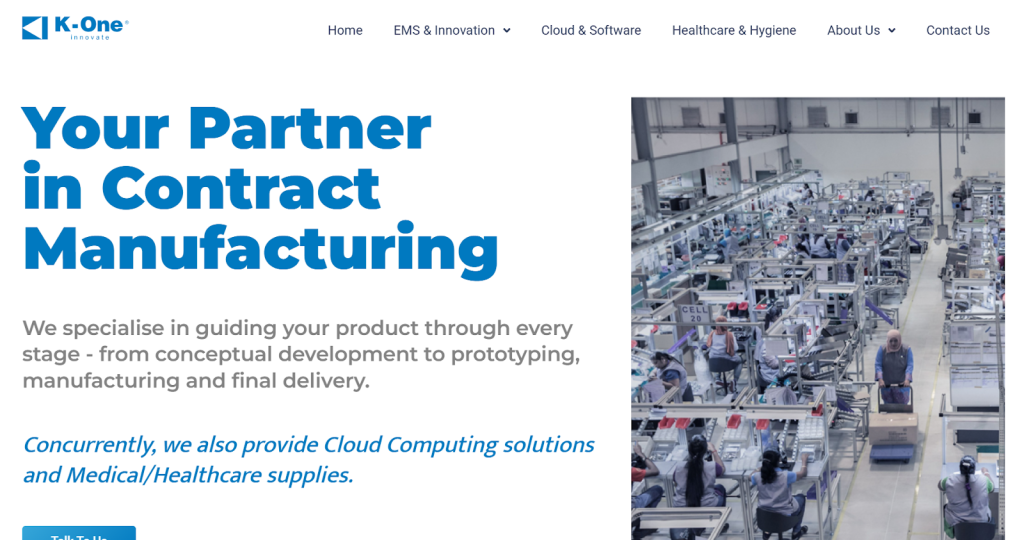
K One Technology provides electronics design and prototyping services with a focus on connected and smart medical devices. Their Selangor based R&D teams support wearables, monitoring systems, and medical IoT products.
They combine hardware development with system integration, which helps teams validate performance and connectivity early. This is increasingly important as medical devices become more digital and data driven.
Best Suited For: Developers of electronic and connected medical devices such as wearables and monitoring equipment.
8. Altek Medical Sdn. Bhd.
Location: Iskandar Puteri, Johor
Founded: 2014
Website Link: https://altekmed.com/
Altek Medical is recognized for its expertise in medical imaging and endoscopy systems. Their Malaysian operations support R&D, prototyping, and early product development for imaging intensive medical devices.
Their strength lies in combining optics, electronics, and mechanical engineering into working prototypes. This supports early clinical evaluation and performance testing for complex imaging products.
Best Suited For: Companies developing imaging, endoscopy, and visually guided medical systems.
9. Integer Holdings

Location: Bayan Lepas, Penang
Founded: 1970
Website Link: https://www.integer.net/
Integer Holdings specializes in life critical medical devices, particularly in the cardiovascular and neurovascular space. Their Penang facility supports prototyping for implants, delivery systems, and precision instruments.
Prototyping at Integer focuses heavily on safety, performance, and regulatory alignment. This makes them a trusted partner for devices where failure is not an option.
Best Suited For: Medical device companies working on high risk and implantable products.
10. Spectrum Plastics Group

Location: Pekan Nanas, Johor
Founded: 2017
Website Link: https://www.spectrumplastics.com/
Spectrum Plastics is a global specialist in medical tubing, extrusion, and fluid management components. Their Johor operations support prototyping of catheters, IV components, and fluid delivery systems.
Their prototyping capabilities allow material testing and dimensional validation before volume production. This is essential for products that interact directly with patients and fluids.
Best Suited For: Companies developing tubing based medical devices and fluid management systems.
The Role of Rapid Prototyping in Medical Innovation
Rapid prototyping plays a critical role in turning ideas into safe and functional medical devices. It allows teams to learn quickly and reduce costly mistakes later.
Moving from Concept to Reality Quickly
Technologies such as 3D printing and CNC machining allow Malaysian companies to create physical prototypes in a matter of days instead of months. Engineers can move quickly from a design concept to a tangible part that can be assembled, tested, and reviewed. This speed is especially valuable during early development, when designs are still evolving.
Fast turnaround also enables multiple design iterations within a short period. Teams can test one version, identify improvements, and immediately apply changes to the next prototype. This rapid learning cycle helps companies refine their devices efficiently without long waiting periods between revisions.
Ensuring Safety and Functionality First
The prototype phase is the safest and most cost effective stage to identify design flaws, usability concerns, and performance risks. Physical testing can reveal sharp edges, weak joints, or awkward user interactions that could affect patient safety or clinical effectiveness. Addressing these issues early prevents them from reaching later stages of development.
By resolving problems during prototyping, companies reduce the likelihood of regulatory delays or failed verification tests. This early focus on safety and functionality helps ensure that the final product performs as intended and meets medical standards before mass production begins.
Key Benefits of Prototyping Your Device in Malaysia
Local prototyping allows closer collaboration between design teams and manufacturers. Being in the same region improves communication, speeds up decision making, and supports more hands on problem solving throughout the development process.
- Access to World Class Engineering Talent
Regions such as Penang have decades of experience in electronics, precision engineering, and advanced manufacturing. This background has created a deep pool of engineers who understand complex systems and regulated industries. Their skills are highly relevant to medical device development, where precision and reliability are critical.
These engineers are familiar with working under strict quality requirements and tight tolerances. Their practical experience helps turn innovative ideas into workable designs that can be tested, improved, and eventually scaled for production.
- Cost Effective Development Cycles
Working with a Malaysian prototyping partner helps reduce overall development costs without compromising quality. Local collaboration minimizes international shipping expenses, customs delays, and coordination challenges that often slow down overseas projects. This allows teams to focus more resources on testing and improvement.
Lower logistical barriers also make it easier to run multiple prototype iterations. Companies can afford to test different materials, designs, or configurations, which leads to better outcomes and fewer costly changes later in the project.
- Adherence to Global Quality Standards
Many medical device suppliers in Malaysia operate under internationally recognized quality systems such as ISO 13485. This means prototyping activities are already aligned with medical regulatory requirements from the beginning. Documentation, traceability, and process control are built into the workflow.
Developing prototypes in a regulated environment helps ensure a smoother transition into validation and production stages. It reduces the risk of compliance gaps and gives companies greater confidence when preparing for audits or regulatory submissions.
What to Look for in a Prototyping Partner
Choosing the right prototyping partner can significantly influence the success of your medical device project. Beyond technical capabilities, factors such as experience, communication, and long term support play an important role. A good partner acts as an extension of your development team.
- Proven Expertise in Your Medical Niche
Medical devices vary widely in design, materials, and usage. A partner experienced in your specific niche will better understand the challenges involved. For example, electronics heavy devices require different expertise compared to plastic disposables or implantable products.
Working with a specialist reduces the learning curve and improves design quality. Experienced partners can anticipate common issues, recommend suitable materials, and suggest design improvements based on similar projects they have supported before.
- Clear Communication and Project Management
Effective communication is essential throughout the prototyping process. A reliable partner provides clear timelines, regular updates, and transparent feedback on technical challenges. This helps ensure everyone stays aligned as the project progresses.
Strong project management also reduces rework and delays. When expectations are clearly defined and progress is tracked closely, design changes can be implemented smoothly without disrupting the overall development schedule.
- Scalability from Prototype to Production
It is often beneficial to choose a partner who can support both prototyping and production. This continuity helps ensure that early design decisions are compatible with manufacturing processes and cost targets. It also reduces the risk of redesign when moving to mass production.
Partners with production capabilities can advise on design for manufacturability during the prototyping stage. This makes the transition from prototype to finished product more efficient and helps shorten time to market.
Conclusion
Medical device prototyping is where innovation begins. With the right partner, ideas can be transformed into safe, effective tools that improve lives. Malaysia’s medical technology ecosystem offers the talent, infrastructure, and regulatory readiness to support this journey from the first sketch to a finished product. Choosing a prototyping partner that aligns with your needs is a crucial step toward success.


