


Introduction
The business landscape in Malaysia has changed significantly in 2026. With the full enforcement of the Cyber Security Act 2024, cybersecurity is no longer simply an IT concern. It has become a legal obligation and a priority at boardroom level. Companies of all sizes, from small SMEs to large government-linked corporations (GLCs), now face the reality that independent cybersecurity audits are essential. These audits provide proof of “Due Diligence” to regulators, insurance providers, and customers alike.
In this guide, we highlight the top cybersecurity audit firms in Malaysia that are equipped to handle these high-stakes requirements. We also explain the critical steps your business should take to ensure compliance, protect sensitive data, and maintain resilience against cyber threats.
This guide is intended for business owners and IT leaders alike. It explains the differences between technical testing and full-scale audits, while providing clear guidance to help you select the right partner for your compliance needs. Whether you are managing a large enterprise or a growing SME, the information here will help you navigate the new cybersecurity landscape in Malaysia with confidence.
Disclaimer
The rankings and descriptions in this guide are based on our own research and analysis. They are intended as a reference and do not represent an official endorsement of any specific firm. We strongly recommend contacting these companies directly to confirm that their services align with your unique needs. All information is accurate at the time of writing, but if you notice any discrepancies, please notify us so we can update the information promptly.
| Table of Contents |
| Introduction |
| Top 10 Cybersecurity Audit Companies in Malaysia |
| Determine If Your Business Needs to Complete an NCII Audit |
| Key Differences Between Cybersecurity Audits and VAPT |
| 4 Most Common Audit Findings in Malaysian Businesses |
| Five Steps to Prepare Your Team for a Cybersecurity Audit |
| Conclusion |
Top 10 Cybersecurity Audit Companies in Malaysia
Cybersecurity audits are a critical part of business operations, providing independent verification that policies, processes, and systems are compliant with regulatory standards. A comprehensive review of cybersecurity auditing methodologies highlights how modern audit practices are evolving toward risk‑based and proactive approaches that align with major regulatory frameworks and improve organisational resilience in the digital era.
The following is a selection of leading cybersecurity audit firms in Malaysia. Each company offers specialised expertise in helping businesses meet regulatory requirements, improve security practices, and protect critical digital assets. These firms are listed as a guide and are not ranked in any particular order.
1. LGMS (LE Global Services)
Location: Subang Jaya, Selangor
Founded: 2005
Website Link: https://lgms.global/
LGMS has built a strong reputation as a local leader in technical cybersecurity auditing. They operate exclusively as an audit firm and do not sell hardware or software products, which ensures that their assessments are fully independent and free from any commercial bias. The company is CREST-accredited and holds multiple PCI certifications, which makes it highly trusted in the banking and payment sectors where regulatory compliance and international standards are crucial. Their audits are known for being thorough and detailed, focusing on identifying gaps that could expose financial institutions to risk.
Best Suited For: Banks and regulated industries needing technically deep, independent audits that satisfy BNM RMiT and international standards.
2. PwC Malaysia

Location: Kuala Lumpur
Founded: 1900s (Local presence)
Website Link: https://www.pwc.com/my/en.html
PwC Malaysia is part of the globally recognised Big Four network and brings credibility that many large businesses rely on. Their cybersecurity audits focus on trust, transparency, and governance, and they explore the intersection of cybersecurity with privacy, corporate governance, and financial reporting. Companies preparing for IPOs, or those that have complex reporting obligations across multiple countries, often choose PwC because their work provides assurance at the board level. PwC also integrates cybersecurity insights with broader business risk analysis, helping companies understand how potential threats could affect their operations and reputation.
Best Suited For: Public Listed Companies (PLCs) and multinational corporations that require global-standard risk assurance and board-level reporting.
3. Deloitte Malaysia

Location: TTDI
Founded: 1968 (Local presence)
Website Link: https://www.deloitte.com/southeast-asia/en.html
Deloitte Malaysia specialises in intelligence-led audits that use real-time global threat data to assess local company defenses. Their approach evaluates a company’s ability to withstand attacks that are currently active in the cyber landscape. Deloitte places a strong emphasis on cyber resilience, which involves not only identifying vulnerabilities but also helping organisations to recover quickly from security incidents. They also offer high-frequency audits for organisations in critical sectors such as energy and telecommunications, helping these companies maintain robust defenses in the face of constantly evolving threats.
Best Suited For: National Critical Information Infrastructure sectors and large enterprises requiring audits informed by threat intelligence and active monitoring.
4. KPMG Malaysia

Location: Petaling Jaya, Selangor
Founded: 1928 (Local presence)
Website Link: https://kpmg.com/my/
KPMG Malaysia is widely recognised for its expertise in auditing emerging technology risks. Their audits address challenges brought about by technologies such as artificial intelligence, blockchain, and the Internet of Things. By combining assessments of legacy IT systems with evaluations of modern digital platforms, KPMG helps companies understand how new threats could affect their operations. This approach ensures that businesses not only meet compliance requirements but are also prepared for technological advancements that could introduce new vulnerabilities.
Best Suited For: Large corporations that require integrated risk advisory and audits aligned with international corporate governance standards.
5. EY Malaysia

Location: Damansara Heights
Founded: 1903 (Local presence)
Website Link: https://www.ey.com/en_my/
EY Malaysia focuses on identity management and cloud security, providing automated audits that give detailed insights into the effectiveness of an organisation’s security controls. Their systems enable businesses to demonstrate compliance with local regulations while also providing assurance to international partners. EY’s methodology is particularly valuable for cloud-native businesses that need fast, transparent, and data-driven auditing processes.
Best Suited For: Fintech companies and cloud-native businesses that require automated audits with a strong focus on identity management and cloud security.
6. Vigilant Asia

Location: Shah Alam, Selangor
Founded: 2017
Website Link: https://vigilantasia.com.my/
Vigilant Asia offers operationally focused audits designed to be actionable and practical. They are a CREST-accredited Managed Security Service Provider and approach audits from the perspective of active threat hunters. Their work prioritises real-world risks and provides SMEs and mid-market companies with clear guidance on what to fix first. This approach ensures that smaller companies can implement meaningful improvements without being overwhelmed by unnecessary technical complexity.
Best Suited For: SMEs and mid-market firms looking for audits that deliver actionable recommendations for immediate improvement.
7. Nexagate
Location: KL Eco City
Founded: 2010
Website Link: https://www.nexagate.com/
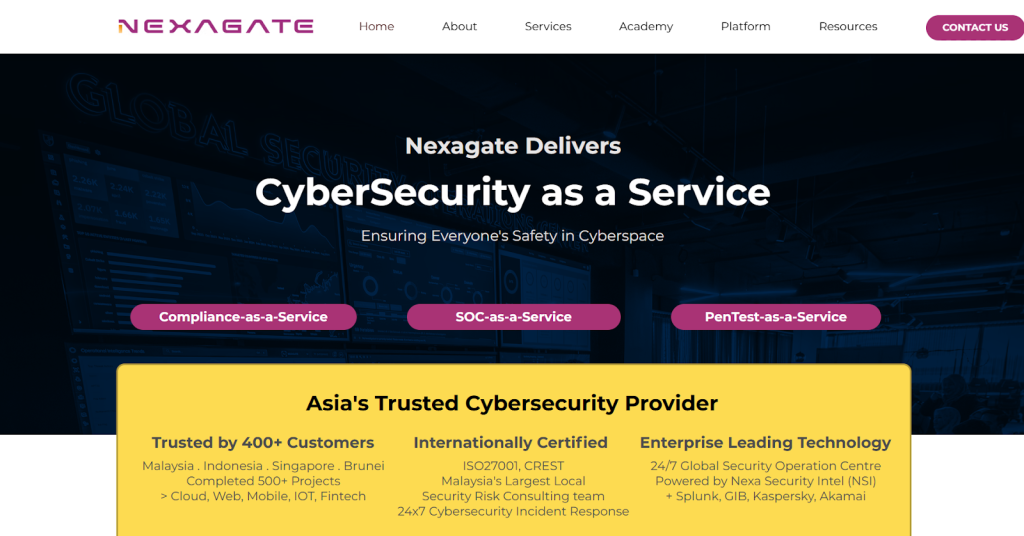
Nexagate is one of the fastest-growing cybersecurity firms in Malaysia and is both ISO 27001 certified and CREST accredited. Their audits are recognised for being highly detailed while remaining agile enough to respond to a client’s changing needs. Nexagate has supported over 400 clients across Asia, helping them achieve compliance and protect critical data assets. Their methodology combines technical expertise with practical guidance, making them a strong choice for businesses experiencing rapid growth.
Best Suited For: Fast-growing technology companies and regional enterprises seeking accredited local expertise and innovative audit approaches.
8. Ofisgate
Location: Cyberjaya, Selangor
Founded: 2003
Website Link: https://ofisgate.com/
Ofisgate is a veteran auditing firm with extensive experience in public sector infrastructure. Their audit processes align closely with NACSA frameworks, which makes them a trusted partner for government agencies and GLCs responsible for managing critical national networks. Their work helps ensure that government data and infrastructure remain secure while meeting strict compliance requirements.
Best Suited For: Government agencies and GLCs that require audits fully aligned with Malaysian national security protocols.
9. Condition Zebra

Location: Petaling Jaya, Selangor
Founded: 2007
Website Link: https://condition-zebra.com/
Condition Zebra is ISO 27001:2022 and CREST accredited. They are licensed by NACSA and specialise in risk management and Secure Software Development Lifecycle audits. Software development companies particularly benefit from their reports, which help secure applications before they are launched to market. Their approach combines technical auditing with employee training and governance assessments to provide a complete cybersecurity perspective.
Best Suited For: Software houses and SMEs that need a comprehensive approach to both technical auditing and cybersecurity training.
10. Tecforte

Location: Petaling Jaya, Selangor
Founded: 2005
Website Link: https://www.tecforte.com/
Tecforte focuses on Operational Technology and collective defense strategies across sectors. Their SectorGard platform enables companies in banking, government, and other critical sectors to protect infrastructure collectively. Tecforte audits include assessments of SIEM systems, log management, and the security of Critical Information Infrastructure. Their work ensures that sectors with shared responsibilities can maintain robust security while coordinating defenses effectively.
Best Suited For: Industrial sectors and sectoral leaders, including the Central Bank, that require audits for collective defense mechanisms and OT security.
Determine If Your Business Needs to Complete an NCII Audit
Under the Cyber Security Act 2024, some businesses in Malaysia are legally classified as National Critical Information Infrastructure, or NCII, entities. Being designated as an NCII entity carries legal responsibilities, including the need to ensure that cybersecurity measures are effective and aligned with regulatory standards.
- Audit Requirement for NCII Entities
All NCII entities are required to undergo a full cybersecurity audit at least once every two years. These audits help verify that organisations are following best practices, maintaining compliance, and actively protecting their critical systems from cyber threats.
- Sectors Classified as NCII Entities
Businesses operating in the following sectors must comply with NCII audit requirements:
- Government and Defence
- Banking and Finance
- Healthcare Services
- Energy, Water, and Waste Management
- Transportation and Logistics
- Information, Communication, and Digital Services
- Agriculture and Plantation
- Trade, Industry, and Economic Development
- Science, Technology, and Innovation
- Consequences of Non-Compliance
Failing to submit an audit report to the National Cyber Security Agency (NACSA) can lead to serious penalties. These include fines of up to RM200,000, imprisonment, or both, depending on the severity of non-compliance.
- Voluntary Adoption by Other Businesses
Even businesses that are not officially classified as NCII entities are increasingly adopting these standards voluntarily. Many e-commerce platforms and fintech companies conduct audits to strengthen their security, reduce the risk of breaches, and avoid fines of up to RM500,000 under the Personal Data Protection Act. These proactive steps also show regulators, partners, and customers that the organisation takes cybersecurity seriously and is prepared for emerging threats.
Key Differences Between Cybersecurity Audits and VAPT
Many business owners in Malaysia often confuse a cybersecurity audit with Vulnerability Assessment and Penetration Testing, or VAPT. While both are critical to a company’s security strategy, they serve very different purposes and provide distinct types of insights. A cybersecurity audit is a comprehensive review of your policies, procedures, and governance, while VAPT focuses on technical vulnerabilities and simulating real-world attacks. Understanding the difference is essential to ensure your business gets the protection it needs.
| Feature | Cybersecurity Audit | Vulnerability Assessment and Penetration Testing (VAPT) |
| Purpose | Evaluates whether your organisation is following established policies, legal requirements, and industry standards. It answers the question: “Are we doing the right things to protect our data, systems, and users?” Audits often review incident response plans, data protection measures, access control policies, staff training, and governance practices. The goal is to identify gaps that could result in regulatory non-compliance or operational risk. | Designed to assess the technical strength of your systems. Vulnerability Assessment identifies potential weaknesses in applications, servers, networks, and devices. Penetration Testing simulates attacks to see if these vulnerabilities can be exploited. The goal is to answer the question: “Could a hacker gain access to our systems?” |
| Focus Areas | People, processes, and governance. Ensures staff follow procedures, policies are up to date, and oversight is properly implemented. | Technical systems, applications, and networks. Identifies misconfigurations, coding flaws, and potential attack vectors. |
| Typical Outputs | Compliance scorecards, gap analyses, and detailed recommendations for improving policies and governance. | Vulnerability reports, proof-of-concept exploits, and detailed remediation guidance for technical flaws. |
| Recommended Approach | Regulators, including Bank Negara Malaysia, recommend a hybrid approach combining both audits and VAPT. Ensures businesses are compliant and actively protected against potential cyber attacks. | Works alongside a cybersecurity audit in the hybrid approach. Provides technical validation and evidence of actual vulnerabilities. |
4 Most Common Audit Findings in Malaysian Businesses
Cybersecurity audits in Malaysia often reveal recurring weaknesses that organisations need to address. Understanding these common issues can help businesses prioritise their security improvements and avoid serious breaches.
- Active Directory Vulnerabilities
Active Directory servers are frequently targeted by ransomware and other cyber attacks in Malaysia. Because these servers control access across an entire organisation, a single compromise can allow attackers to take over multiple systems, potentially bringing business operations to a halt. Auditors pay close attention to account permissions, password policies, and administrative controls to ensure that AD systems are properly secured.
- Cloud Misconfigurations
With a growing number of Malaysian businesses adopting hybrid cloud environments, misconfigured cloud storage and weak API controls have become widespread issues.Open storage buckets, excessive permissions, or improperly configured network access can lead to accidental data exposure or breaches. Auditors look for these weaknesses and provide guidance on how to lock down cloud resources and implement secure cloud practices.
- Shadow IT Usage
Employees frequently use unauthorised tools, AI software, or personal cloud services to perform their work, bypassing official security controls. While these tools may improve productivity, they also introduce risks because sensitive company data is being processed outside approved systems. Audits identify such shadow IT usage and provide recommendations for balancing security with operational efficiency.
- Inactive Accounts
Accounts belonging to former employees that have not been properly deactivated continue to pose a significant security risk. These dormant credentials can be exploited by attackers to gain access to systems undetected. Auditors emphasise the importance of regular account reviews, timely revocation of privileges, and strict access management practices.
Five Steps to Prepare Your Team for a Cybersecurity Audit
Proper preparation is essential to ensure that an audit is efficient, thorough, and produces actionable results. By addressing potential gaps before the auditor arrives, companies can save time, reduce costs, and strengthen overall security posture.
- Inventory Your Assets
You cannot secure what you do not know exists. Begin by creating a comprehensive inventory of all digital assets, including servers, laptops, cloud instances, IoT devices, and any networked systems. This master list will serve as the foundation for understanding potential exposure points and for demonstrating compliance during the audit.
- Review Access Controls
Ensure that the principle of least privilege is applied across all systems. Employees should only have access to the data and systems necessary to perform their specific roles. Auditors will review access permissions to ensure that no one has excessive privileges, and that role-based access controls are enforced consistently.
- Document Your Policies
Auditors will request key documentation such as your Incident Response Plan and Data Protection Policy. These policies should be fully updated for 2026 and signed off by senior management. Comprehensive documentation demonstrates governance maturity and shows that your company takes cybersecurity seriously.
- Check Your Backups
Regular backups are essential, but it is equally important to verify that they are secure. Backups should be isolated or air-gapped to ensure that ransomware or other malware cannot compromise them. Auditors will review backup schedules, retention policies, and restoration procedures to confirm that they are reliable and effective.
- Audit Your Vendors
Under the Cyber Security Act 2024, companies classified as National Critical Information Infrastructure (NCII) entities are legally responsible for the security of third-party software and services they use. These organisations must review their supplier agreements and ensure that security responsibilities are clearly defined. Auditors will specifically look for evidence that vendors follow recognised security standards and that risks arising from third-party systems are properly identified, assessed, and managed in accordance with NCII compliance requirements.
Conducting a well-planned cybersecurity audit not only ensures compliance but also strengthens organisational security posture. Research that developed a Cybersecurity Audit Index demonstrates how the effectiveness of cybersecurity audits is linked to higher cyber risk management maturity and can inform how audit planning, performance, and reporting contribute to stronger organisational security practices.
Conclusion
A cybersecurity audit should never be feared or seen as a punitive exercise. It is a vital business health check that provides an opportunity to strengthen your organisation, improve risk management, and demonstrate compliance. In 2026, cyber incidents are rising across Malaysia, and the most successful companies are those that act proactively rather than reactively.
Engaging a qualified auditor today is an investment in the future of your business. Not only does it protect sensitive data, but it also strengthens trust with regulators, partners, and customers. By taking cybersecurity seriously and implementing the recommendations from a thorough audit, your company can remain profitable, resilient, and respected in an increasingly digital business world.


